
Environmental Product Declaration
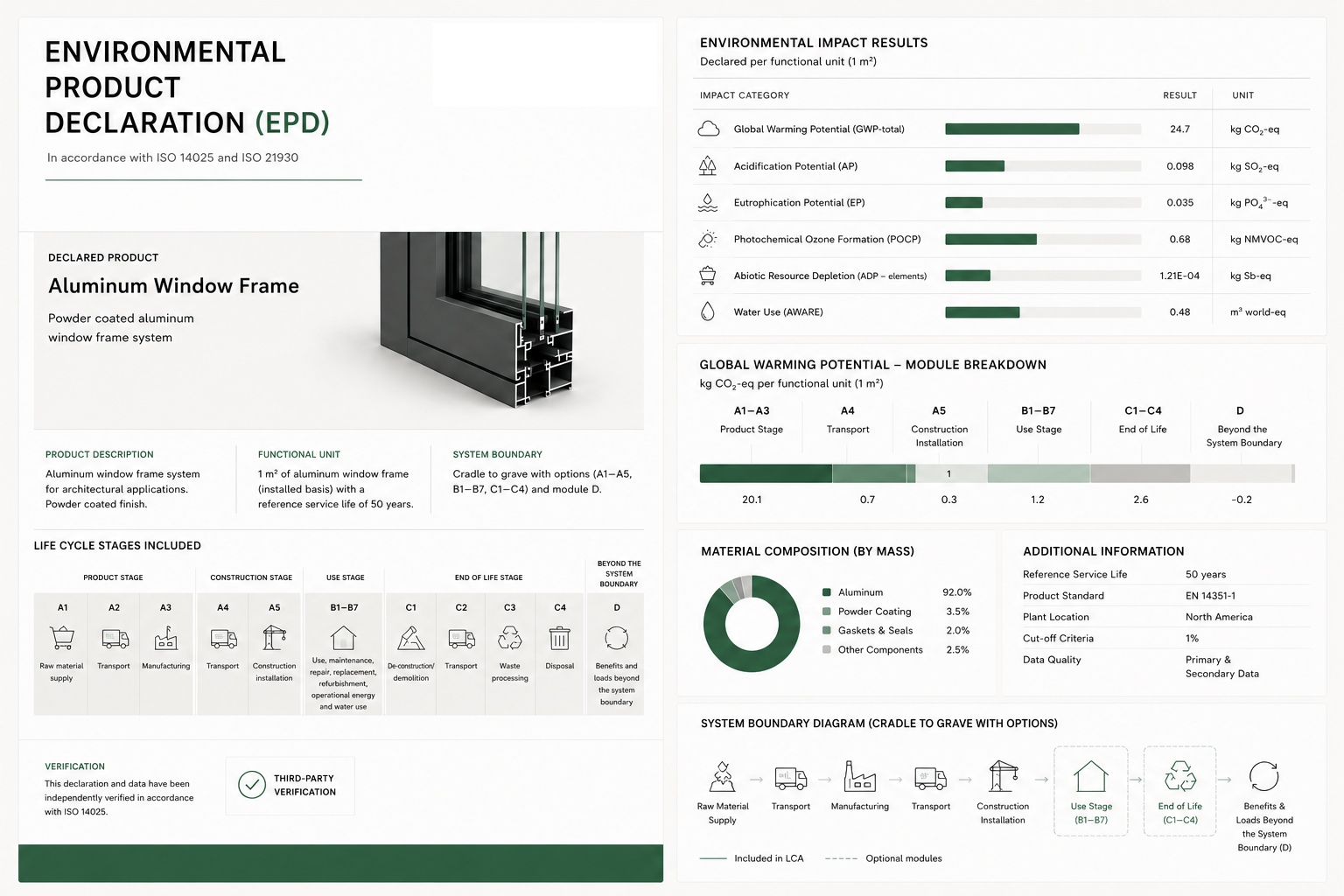
ISO 14025 . ISO 21930 . EN 15804An Environmental Product Declaration (EPD), or Type III environmental declaration, is a standardized and independently verified disclosure that communicates a product’’s environmental impacts based on life cycle assessment (LCA). EPDs translate complex life cycle data into a transparent format that can support procurement, specification, product comparison, environmental disclosure, and market access.
What is an EPD and How Does it Work?
An Environmental Product Declaration (EPD) is often described as a “nutrition label” for a product’s environmental performance. It provides third-party verified life cycle assessment data in a standardized, transparent, and comparable format.
EPDs are developed and verified in accordance with internationally recognized standards, including ISO 14025 and, for construction products, ISO 21930, and EN 15804 in Europe, as well as the applicable Product Category Rules (PCRs) and programme operator requirements.
Programme operators are organizations, trade associations, or agencies that administer EPD programmes. Their role includes establishing or managing product-specific rules, overseeing EPD registration and publication, maintaining EPD libraries, and ensuring that independent verifiers meet defined competence requirements.
In Canada, CSA Group operates an accredited EPD Programme. Dr. Shiva Zargar, Founder and Director of Science and LCA at Build Neutral, is an accredited CSA EPD Verifier and the first CSA EPD Verifier based in Alberta, Canada.

Our Environmental Product Declaration Services
Build Neutral supports the full EPD pathway, from identifying the appropriate program operator and Product Category Rule (PCR) for your specific product, to early scoping, LCA modelling, EPD development in accordance with ISO 14025, ISO 21930, EN 15804, and applicable PCR requirements, through to verification coordination and publication readiness.
EPD Development
Build Neutral develops EPDs based on life cycle assessment (LCA) and the applicable product category rule (PCR). We support the full technical workflow, including product and declared unit scoping, system boundary definition, data collection, life cycle inventory modelling, impact assessment, data quality evaluation, EPD report preparation, programme operator coordination, and verification readiness.
Best for:
manufacturers
material producers
construction product suppliers
organizations preparing product-level environmental disclosure for procurement, specification, market access, or sustainability reporting.
EPD VERIFICATION
Build Neutral provides independent EPD verification to assess whether the EPD, underlying LCA study, data sources, assumptions, calculations, and reporting are consistent with the applicable Product Category Rule (PCR), ISO requirements, and programme operator instructions.
Build Neutral provides EPD verification through Dr. Shiva Zargar, an accredited EPD verifier with the CSA Group.
Best for:
Organizations that already have a draft EPD, supporting LCA report, calculation model, or product disclosure package prepared for independent third-party review.
New to Environmental Product Declarations?
Read our article on Type III Environmental Declarations to understand how EPDs support transparency, market access, and credible environmental claims.
The Path to a Published EPD
1
Define the EPD pathway
The process begins by selecting the right Program Operator (the body that manages EPD programs) and the applicable PCRs. PCRs define how LCAs should be performed for a specific product type, ensuring your EPD is comparable to others in the same category.
2
Conduct the LCA
An LCA is developed to measure your product’s environmental impacts across its life cycle. This includes energy and material inputs, emissions, waste, and other relevant factors, following the rules set by the PCR.
3
Develop the EPD
The LCA results combined with PCR requirements are organized into a standardized EPD format. This document summarizes your product’s environmental profile in a clear, transparent way, similar to a “nutrition label” for sustainability.
4
Verify the EPD
The draft EPD undergoes independent third-party verification to ensure the data, methods, and reporting meet ISO standards, PCR, and program operator requirements. Verification confirms that the declaration is accurate, credible, and defensible.
5
Register and publish the EPD
Once verified, the EPD is registered and published through the selected programme operator, making the product’s environmental data available for disclosure, procurement, and specification.
Why Develop an EPD?
EPDs are becoming a critical tool for product transparency, embodied carbon disclosure, procurement, and green building programs. They help manufacturers communicate environmental performance using a standardized, verified format rather than broad sustainability claims.
Product Transparency

Communicate verified environmental information in a standardized format.Procurement Readiness

Support customer, project, and public-sector requests for embodied carbon and environmental data.Market Access

Strengthen eligibility for projects where EPDs are requested or preferred.Embodied Carbon Reporting

Provide product-specific data for building and infrastructure carbon assessments.Environmental Claims Support

Support credible, evidence-based communication about product impacts.Design & Improvement

Identify environmental hotspots and opportunities for product or process improvement.EPDs in Procurement and Policy
Environmental Product Declarations (EPDs) are becoming essential across North America as governments, industry standards, and green building programs demand greater transparency in construction materials. They are now a cornerstone of procurement, compliance, and design decisions in both Canada and the U.S. Having an EPD can set your product apart from competitors who have not yet invested in one.
While EPDs are most visible in the construction sector, they are valuable in many other industries. Because Life Cycle Assessment (LCA) is a flexible methodology, the greenhouse gas (GHG) indicators it uses apply consistently to any product or process.
Both government and industry are moving toward a dual approach: simplified assessments at the pre-design stage, and more detailed assessments for as-built projects. These are increasingly tied to certification and procurement requirements.
Some key examples of where EPDs are being referenced today:
National Research Council Canada (NRC)
The Whole Building Life Cycle Assessment (wbLCA) Guidelines highlight EPDs as a reliable source of data for calculating environmental impacts, including life cycle flows and bills of materials. The guidelines identify two common data sources for building assessments: LCA databases and EPDs.
Government of Canada
The Standard on Embodied Carbon in Construction sets minimum requirements for federal procurement of design and construction services. Section 3.2.3.2 requires disclosure of the embodied carbon footprint of structural materials, measured as global warming potential (GWP), using EPDs. If no EPD is available, an ISO-compliant LCA report reviewed by a qualified verifier may be accepted.
American Society of Civil Engineers (ASCE)
The Prestandard for Assessing the Embodied Carbon of Structural Systems for Buildings is expected to see wide adoption.
Why Build Neutral for EPDs?
EPDs require more than filling out a template. They require defensible LCA modelling, careful PCR interpretation, transparent data handling, and an understanding of verification expectations. Build Neutral brings scientific depth, standards knowledge, and practical experience across LCA, EPD development, verification, critical review, and environmental disclosure.
Doctoral-Level LCA Expertise
EPD work led by LCA scientists with advanced expertise in environmental modelling, ISO methodology, and product-level disclosure.
Standards-Oriented
Alignment with ISO 14025, ISO 14040/44, ISO 21930, EN 15804, applicable PCRs, and programme operator requirements.
Verification-Aware
Developed with third-party verification expectations, documentation quality, and review readiness in mind.
Disclosure-Ready
Designed to support credible product transparency, procurement, specification, embodied carbon reporting, and environmental claims.
Developing a new EPD or updating an existing one?
Build Neutral supports manufacturers, material producers, and industry associations and stakeholders seeking credible, transparent, and standards-aligned Environmental Product Declarations; whether developing a first EPD, verifying a new declaration, or updating an expired EPD to reflect current data, PCR requirements, programme operator rules, and market expectations.